Liège and Brussels · Air cargo, perishables and pharma stores

Cold chain monitoring in Liège and Brussels, from the apron to the cool room

Spatial Map shows each cool room, freezer and dock of a building on a live 3D map, coloured by the latest reading from your sensors, with doors, pallets on hold and the history of what changed. Cold chain monitoring in Liège and Brussels is an air-cargo job: freight arrives on freighters and in the holds of passenger flights, waits in cool rooms against a departure or a pick-up slot, and the minutes it spends out of range are what the shift lead needs to see. Your probes and monitoring system measure; the map shows where.

No credit card. Runs in the browser. Pro is $60/month for up to 4 facilities. Book a demo

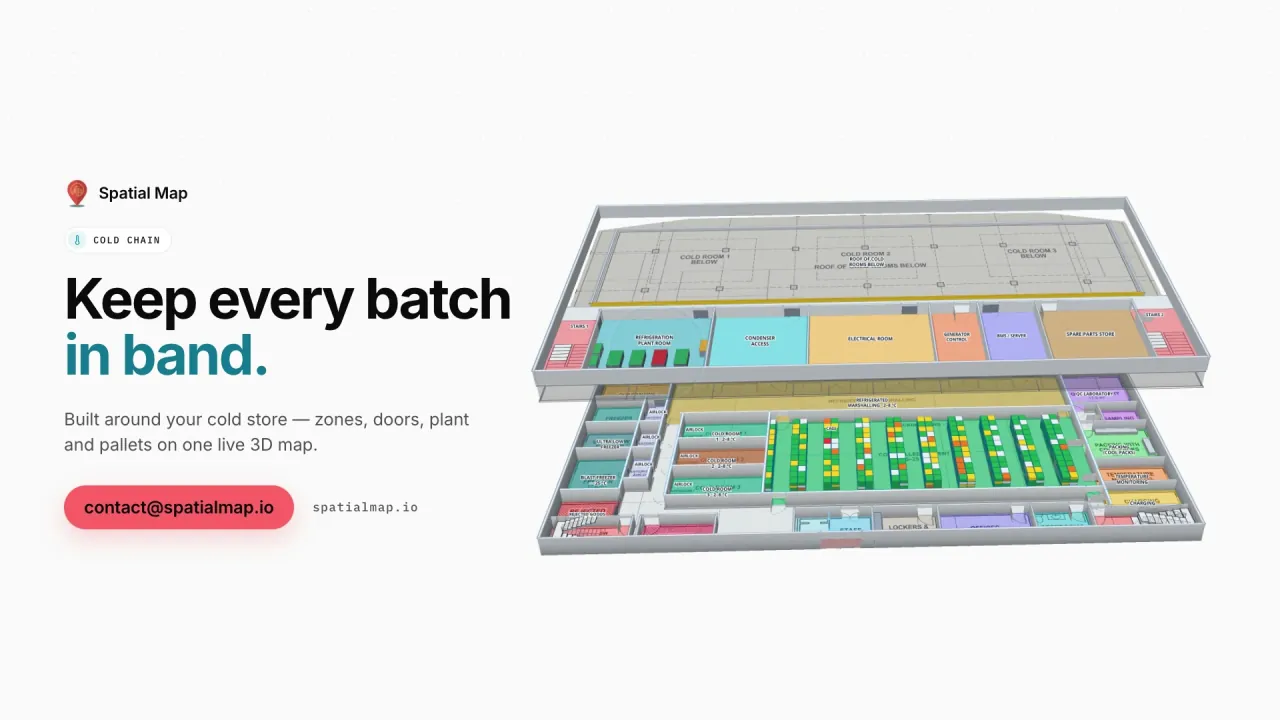
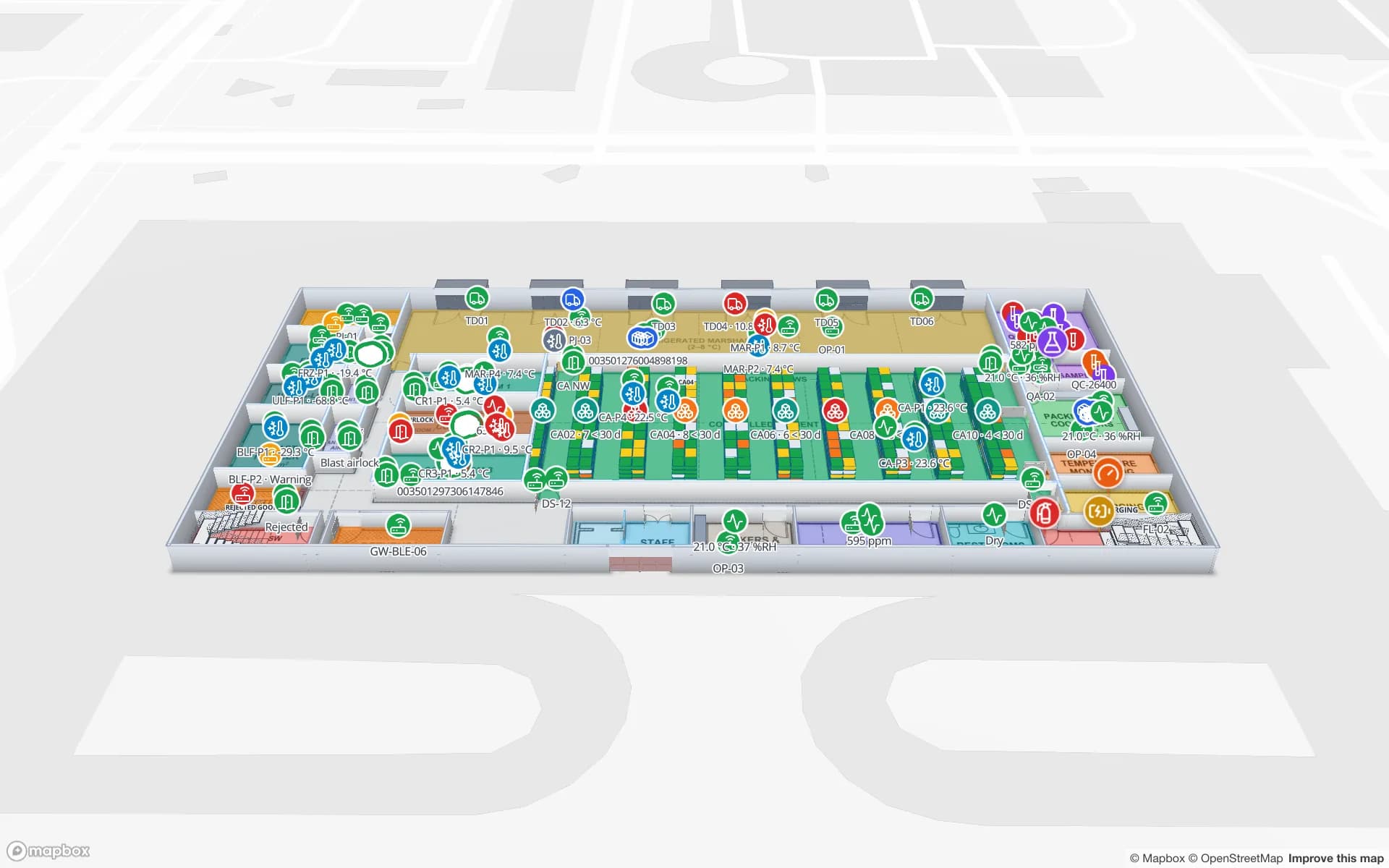
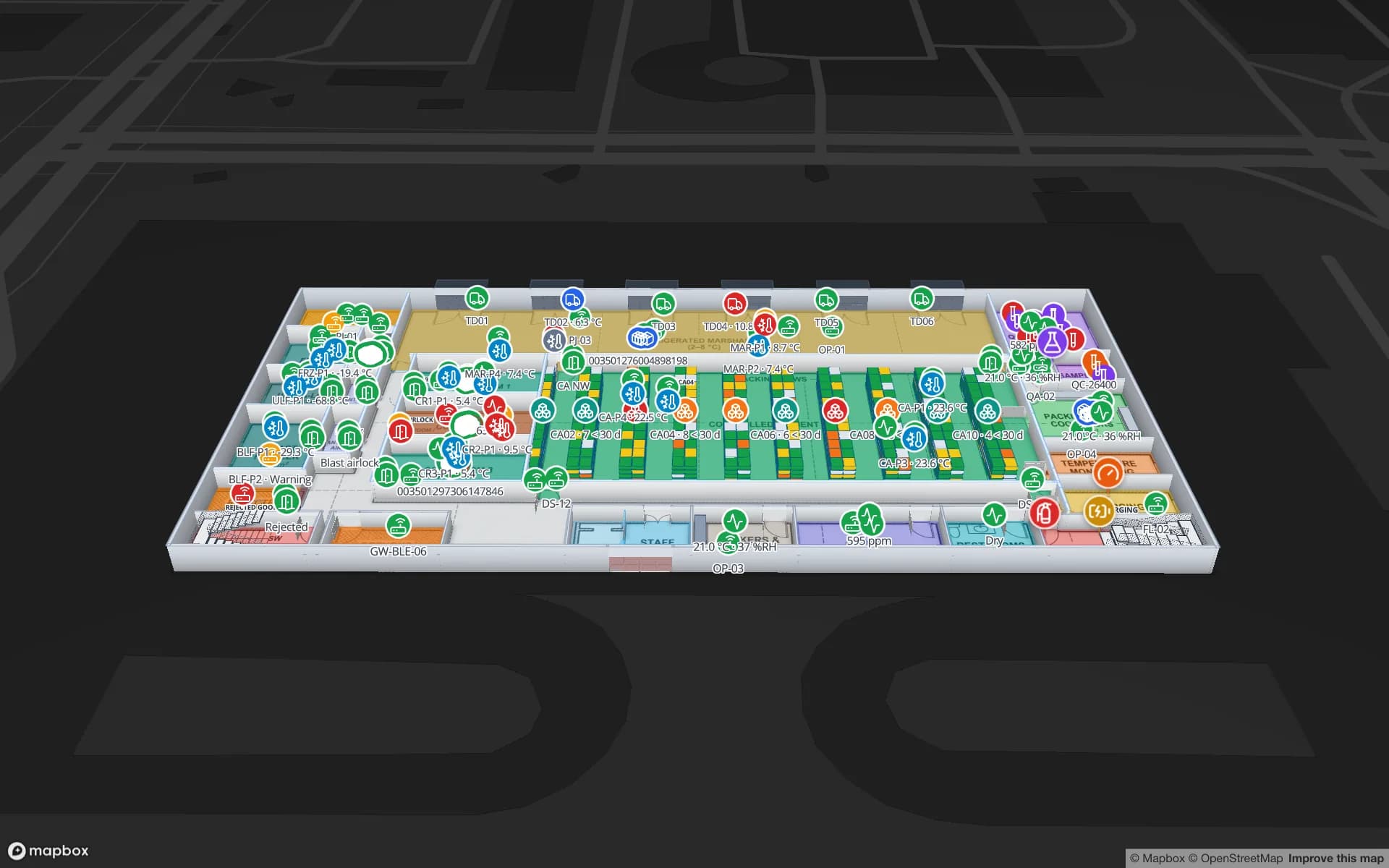
Polar Pharma — Cold Storage & QC Facility, a pharmaceutical cold store & qc lab demo, in the Spatial Map 3D viewer with live device markers
Polar Pharma — Cold Storage & QC Facility
Polar Pharma, a demo cold store and QC facility: cold rooms, freezers and controlled-ambient storage with 1,140 rack locations, reefer docks and quarantine.
Rack locations in the Polar Pharma demo cold store
1,140
How often alert rules are checked, with alerts shown in the app
15 s
Interface languages for Wallonia, Brussels and the east, plus ES, AR and ZH
FR · DE · EN
Free trial, up to 5 facilities, no card
7 days

Liège Airport and CargoLand: 24/7 freight, and a growing cool chain

Liège Airport launched its CargoLand programme on 3 June 2025: 90 hectares of land for logistics development, a 38,000 square metre first-line warehouse, digital shipment tracking and stronger rail, road and sea links. The airport describes unrestricted 24/7 operations without curfews or slot constraints and says it is within a one-day truck drive of 75 % of European GDP centres; those are its own claims, and its pitch is freighter-first with e-commerce, pharmaceuticals, perishables and live animals as commodities.

The cool chain there is concrete: a fully temperature-controlled handling area for perishables opened at the airport in 2025, and the airport’s own material also points to pharma and flowers as communities it wants to grow. A shipment that lands at night is built up, held in a cool room and trucked out, and the evidence that it stayed in range lives in several systems. Spatial Map puts the rooms, the doors and the readings on one plan, so a supervisor sees which room is out of range now and which pallets are in it. See temperature monitoring and the Cold Chain solution.


Brucargo at Brussels Airport: new buildings, more cold space

Brussels Airport handled about 733,000 tonnes of cargo in 2024. Its Brucargo Central redevelopment, a EUR 70 million project launched in 2022 and reported as inaugurated in October 2025, replaced eight buildings from the 1980s with three new ones on 83,500 square metres. The airport says storage capacity rose by 30 % on the same site, that 10,000 square metres of temperature-controlled space was added, bringing cold storage in the cargo area to about 45,000 square metres, and that more than 100 companies operate in the cargo area.

New cold space means new rooms to map, name and watch, usually shared by several handlers with their own sensors and sheets. Draw each room and door on the plan, bring each handler’s readings in through a table, and give each company a read-only share link limited to its own floor and layers, with an expiry date and no account. The Polar Pharma demo shows the pattern in one building: temperature zones, doors, reefer docks and quarantine areas, with 1,140 rack locations.

What a monitoring rule can and cannot do

Alert rules run on your tables and are checked every 15 seconds: a row matches (a room above 8 °C), matches for N minutes (above 8 °C for ten minutes, so a door opening does not page anyone), or is not updated for N minutes (a sensor that went silent). Each rule has a severity and a message template, and notifies roles or members; the alert closes itself when the room is back in range, and people can acknowledge and resolve it and jump to the room with Show on map.

Alerts are in-app only: the bell, a pop-up and the Alerts page. Spatial Map sends no email, SMS or push, so paging out of hours stays with your monitoring system. It does not control equipment, replace calibrated loggers or certify anything: your quality system, procedures and records stay the record, and Spatial Map makes no GDP or other compliance claim. What it adds is the view — which rooms, which doors, which pallets — and a History player that replays the last hours when someone asks what happened. The post on warehouse sensor alert rules lists the patterns.

French first in Liège, three languages in Brussels

Liège is French-speaking, Brussels is bilingual, and the east of Wallonia has a German-speaking community. The Spatial Map interface is available in French, German and English, with Spanish, Arabic and Chinese, and each user picks their own; a French-speaking shift lead and an English-speaking handler can work on the same facility. It is not yet available in Dutch, so Flemish colleagues work in English; room names, product names and report titles stay in whatever language you type them.

Airports are shared buildings with security and access rules of their own; mapping a room does not give anyone access to it, and a share link shows only what you publish. Our team works with Belgian customers remotely, by video call and through the contact form, in French, German or English.

Beyond the airport: food and pharma stores around both cities

Cold stores are not only at airports: distribution centres, food-processing buildings and pharma depots around both cities all hold temperature-controlled stock. The Belgium page covers pharma and distribution centres in general; here the unit is the cool room next to the apron. The usual first step is the same: one room, one table of readings, one rule, and then the rest.

For a pharma depot the useful extras are quarantine areas and held pallets: a batch waiting for release is shown where it stands, and the report of what was in which room can be exported as PDF or Excel for a review. For perishables — flowers, fruit, fish — the useful extras are dwell time and door events: how long a pallet waited at the dock between the plane and the cool room.

Services for teams in Liège and Brussels

Where teams usually start:

Also served nearby

The same approach covers the industrial parks around both airports, Zaventem and Machelen near Brussels, Namur, Charleroi, Leuven and Mechelen. Our team can also set up a first facility for you remotely as a custom service, in French, German or English.

How Spatial Map does it

From one cool room to the whole cargo shed

  1. 01

    Pick one room

    A perishables room, a pharma chamber or a freezer — wherever time out of range costs most.

  2. 02

    Draw rooms, doors and docks

    Upload the plan, let AI Map draft it for review, and draw each chamber as an area with its sensors and doors.

  3. 03

    Connect probes

    Your monitoring system or gateway posts readings through the write API, or Spatial Map polls its REST endpoint.

  4. 04

    Add range and silence rules

    In-app alerts for readings out of range for N minutes and sensors silent for N minutes; replay with History.

What teams around Liège and Brussels monitor

Perishables and flowers in cool rooms

Room temperatures, door states and dwell time between the aircraft and the cool room.

Pharma depots and quarantine

Temperature zones, held pallets and quarantine areas with exportable reports.

Air cargo build-up and cross-dock

Docks, staging lanes and shipments against the departure time.

Ground equipment and ULD pools

Dollies, ULDs and equipment as tagged assets with last-seen area.

See it on real demo facilities

Fictional names, real floor plans, live sensors, RFID, BLE tags and gateways — open any of them in the browser.

All 13 demo facilities

Cold chain monitoring in Liège — questions we get

No. It shows live temperatures, door states, quarantine and held stock on the map, keeps row history and exports reports. Your quality system, calibrated loggers, procedures and records remain the record, and Spatial Map makes no GDP or other compliance claim.

Not by itself. Alerts are in-app only — the bell, a pop-up and the Alerts page — and close themselves once the room is back in range. There is no email, SMS or push, so out-of-hours paging stays with your monitoring system.

Yes. Your monitoring system or gateway posts readings to a table with the write API (HTTPS, bearer API key, bulk upsert, 60 requests per minute per key), or exposes a REST endpoint that Spatial Map polls. Rooms are coloured by style rules on the value. Spatial Map does not read probes directly.

Yes. Read-only share links show only the floors and layers you choose, with an expiry date and a view cap, and can be revoked at any time. The viewer needs no account.

Yes, in French, German and English as well as Spanish, Arabic and Chinese; each user picks their own. It is not yet available in Dutch. Your own room names and report titles stay in any language you type.

No. Spatial Map is sold online and our team works with customers in Belgium remotely, by video call and through the contact form, in French, German or English. There are no local resellers or partners.

In US dollars, the same worldwide: a 7-day free trial for up to 5 facilities with no card, then Pro at $60 a month or $600 a year for up to 4 facilities. Larger estates are quoted as custom services; sensors and hardware are quoted per project.

Put one cool room on the map before the next night flight.

Start the free trial and open the Polar Pharma demo, or send us the plan of one cool room or cargo shed and a sample of your readings through the contact form.