
How far can RFID be read? Read ranges by type, and what shortens them
How far can RFID be read? Typical ranges for passive UHF, HF, NFC and active RFID, what cuts them short, and what read range means for gates and handhelds.


How far can RFID be read? The short answer
How far can RFID be read? It depends mostly on the type. A passive UHF tag is typically read from about one to several metres with a handheld, and often 5–10 m or more with a fixed reader in good conditions. Passive HF tags read from a few centimetres to about a metre, NFC from a few centimetres, and battery-powered active RFID from tens of metres up to around 100 m in open space, according to published specs.
Those numbers are the best case, measured in open air with the tag facing the antenna. In a real warehouse or shop, the product the tag is stuck on and the things around it often matter more than the reader. This guide explains the ranges, what shortens them and how to think about range for gates and handhelds.
Typical read range by RFID type
The table below gives typical ranges taken from published reader and tag specifications. Use them to shortlist a technology, never to promise a result. Vendors measure in ideal conditions, and two tags of the same frequency can differ by a factor of two or more.
| RFID type | Frequency | Typical read range | Power source | Typical use |
|---|---|---|---|---|
| LF passive | 125–134 kHz | A few cm to about 10 cm | Reader field | Access cards, animal tags |
| HF passive | 13.56 MHz | A few cm to about 1 m (large antennas) | Reader field | Smart shelves, libraries, cabinets |
| NFC | 13.56 MHz | A few cm | Reader field (often a phone) | Tap to check, authenticate or open a record |
| UHF passive (RAIN) | 860–960 MHz | About 1–5 m handheld; often 5–10 m+ fixed | Reader field | Stock counts, dock doors, retail exits |
| Battery-assisted passive | UHF | Longer than passive, often tens of metres | Small battery helps the tag | Containers, sensor tags |
| Active RFID | Commonly 433 MHz or 2.45 GHz | Tens of metres, up to around 100 m in open space | Battery in the tag | Vehicles, yards, large assets |
If you are still choosing a frequency, the UHF vs HF vs NFC comparison covers standards, tag cost and phones in more detail.
Why passive RFID has a ceiling
A passive tag has no battery. It wakes up only when the reader’s radio wave gives its chip enough energy, then answers by reflecting part of that wave back. Two links have to work: the reader must power the tag (the forward link), and the reader must hear the weak reply (the reverse link). With modern UHF readers, the forward link is usually the limit. The tag simply does not get enough energy beyond a certain distance.
Regulators also cap how much power a reader may radiate, and the limits and frequency bands differ by region. That is one reason readers ship in regional variants, and why a range quoted for one country does not always carry over to another.
Active RFID avoids the ceiling by putting a battery and transmitter in the tag. The price is a bigger, more expensive tag that needs a battery change or replacement after its service life.
What affects RFID read range
- The tag antenna. Bigger antennas usually read further. A small jewellery or IT-asset tag can read at a fraction of the distance of a long label inlay.
- The chip. Newer chips need less energy to wake up, so the same antenna reads further. Datasheets call this read sensitivity.
- Reader power and antenna gain. A fixed reader with a directional antenna reaches further than a handheld’s small built-in antenna. Most readers let you lower the power on purpose.
- Metal. A standard UHF label on a metal surface is detuned and may not read at all. On-metal tags use a spacer or special design to fix this.
- Liquids and people. Water absorbs UHF energy. Drinks, cosmetics, meat and human bodies all shorten range, sometimes dramatically.
- Orientation and polarisation. A thin label read edge-on can disappear. Circularly polarised reader antennas are less sensitive to orientation than linear ones, at some cost in range.
- Tag density. Tags packed tightly together can shadow each other, so the middle of a full carton reads worse than its edges.
- The room itself. Reflections from racks, floors and walls create dead spots and unexpected hot spots. Other readers and radio sources can interfere.
Metal, liquids and apparel each have their own tag families. See RFID tags for metal, liquids and apparel for what to test.
What read range means for gates and handhelds
Longer is not always better. The right range depends on the job the reader does.
- 1Gates and portals: control the zone
At a dock door or shop exit you want every tag that passes through, and none of the tags on the shelf two metres away. Too much range causes stray reads, where a gate reports items that never left. Installers usually tune power, antenna angle and shielding until the read zone matches the doorway.
- 2Handhelds: range is a trade-off
High power reads a whole shelf from the aisle, which makes counts fast. Lower power lets a person find one item among many, which is what "locate" or "Geiger counter" modes on handhelds rely on. Most counts work best somewhere in between.
- 3Fixed overhead readers: coverage, not reach
Ceiling readers cover an area. Range sets how many you need, so a site survey with your real tags decides the spacing.
- 4Conveyors and tunnels: speed matters
A carton on a fast belt spends a short time in the field. Range and reader settings must leave enough time to read every tag in it.
For a fuller comparison of the reader types, read RFID handheld vs fixed reader vs gate. If a gate is already installed and misses tags, the RFID read rate guide walks through the usual causes.
How to test read range on your own products
- 1Pick the worst cases
Choose the products that are hardest to read: metal, liquids, dense packs, small items. If those read, the rest will.
- 2Use the real reader and antenna
Ranges from a demo kit rarely match the hardware you will install.
- 3Test in place
Measure at the actual door, shelf or conveyor, with racks, people and other readers present.
- 4Vary orientation and speed
Turn the item, stack it, move it at walking speed or belt speed, and record the read rate, not just one distance.
- 5Write down the settings
Record power, antenna position and tag model, so the result can be repeated when you roll out.
Seeing where reads happen
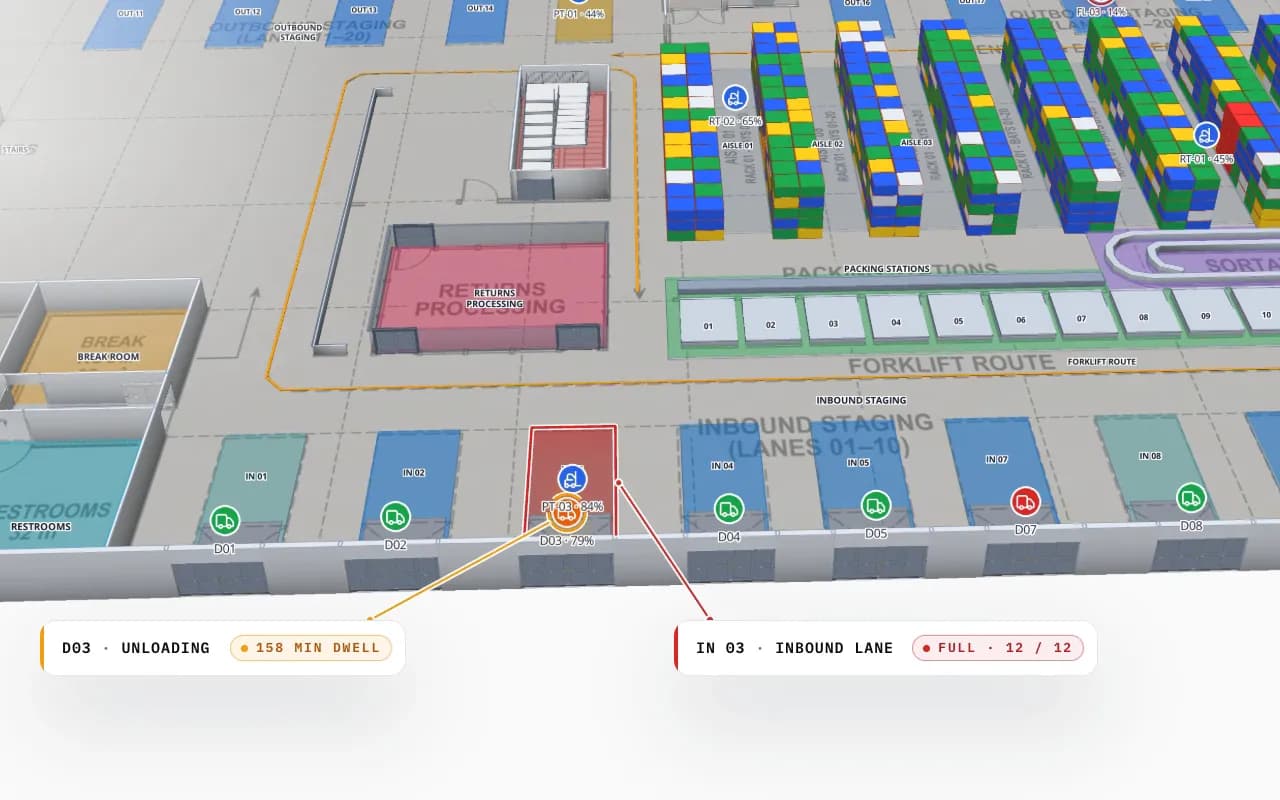
Range problems are often location problems: a gate reading tags from the wrong side, or a dead spot at the end of an aisle. Spatial Map shows RFID reads on a 3D floor plan of the building, next to the reader that produced them, so odd patterns stand out. It does not set reader power or read tags itself; your readers or middleware send their reads to a table, and the map shows them. See RFID asset tracking software and RFID gate systems.
Quick answers
Can a phone read RFID from far away? No. Phones read NFC tags from a few centimetres. Reading UHF tags needs a dedicated reader or a reader sled attached to the phone.
Can passive RFID be read through walls? Sometimes, through thin non-metal walls, but at reduced range. Walls with metal studs, foil insulation or concrete with steel rebar block or reflect much of the signal.
Does a longer read range make RFID less secure? It can make unwanted reads more likely, which is why gates are tuned down rather than up. Data protection depends on what is stored on the tag and in your systems, not on range alone.
What is the longest-range RFID? Active RFID, with a battery in the tag. Published specs commonly quote tens of metres and up to around 100 m in open space.
Try the platform your data belongs on.
Spatial Map turns spreadsheets, sensor streams, and CAD drawings into one live 3D facility view — nothing to install, seven-day free trial.
Keep reading
- Deep-diveAzure Maps Creator is retired: what it means and your optionsMicrosoft retired Azure Maps Creator on 30 September 2025 and deleted its indoor data. What Creator did, what you can still rebuild from, and how to choose where to move.
- Deep-diveHow accurate are BLE beacons? Four methods, and why results varyFrom room-level to sub-metre: BLE accuracy depends on the method, the building and the update rate. The four methods, what affects them and seven questions for vendors.
- Deep-diveDoes GPS work indoors? Why it fails and what works insteadGPS barely works inside buildings: the signals are too weak and bounce off everything. Here is why, how indoor positioning options compare, and why each one still needs an indoor map.