
RFID tags for metal, liquids and apparel: how to choose
RFID tags for metal, liquids and apparel: why ordinary tags fail on steel and water, on-metal and liquid-ready options, carton and pallet labels, and testing.
The tag is the part that decides
Readers get the attention, but the tag decides most RFID outcomes. A UHF tag is a chip plus an antenna tuned to work on a particular kind of material. Put a tag designed for cardboard on a steel toolbox or a bottle of water and it will read poorly or not at all — not because RFID “does not work on metal”, but because that tag was never designed for it.
Metal: tools, servers, cages and cans
A standard UHF inlay laid flat on metal is detuned by it. On-metal tags solve this by separating the antenna from the surface (foam or plastic spacers, flexible “flag” tags that stand off the surface) or by using the metal as part of the antenna (hard tags with a ground plane, ceramic or PCB tags). On-metal tags are thicker and cost more than paper inlays, but read well — often better than on cardboard.
- Tools and instruments — small rugged tags, sometimes embedded in a drilled pocket; check temperature and chemical resistance.
- Servers and IT kit — thin on-metal labels on the bezel or rail where the handheld can see them.
- Roll cages and returnable metal — rugged tags that survive impacts and washing.
- Cans and foil packs — a hard case for item-level; often tagged at case or pallet level instead.
Liquids: bottles, vials and fresh food
Water and water-rich products absorb UHF energy, so a tag on the side of a full bottle sees less signal. Work with the geometry: tag the cap or neck, use a hang tag that sits in air, or a tag designed for liquids. For small vials and lab samples read at close range, HF often works better — see UHF vs HF vs NFC.
Apparel and soft goods
Apparel is where item-level UHF RFID took off because it is RF-friendly: fabric barely affects the tag. The choice is mostly practical: a hang tag or price ticket with an inlay (removed at sale), an adhesive label on packaging, or a sewn-in care label for items that are tracked through laundries and rentals (wash-proof tags exist for that). Inlay size trades range against how small the label must be.
Cartons and pallets
Shipping labels with an RFID inlay are printed and encoded in one pass by RFID printer-encoders. On pallets, tag at least two sides so a portal sees one whatever the orientation, and keep tags away from metal straps and liquid-filled layers. Encode an SSCC for logistics units and SGTIN for trade items, so every system agrees what a read means.
Choosing tags by use case
| Use case | Tag type | Watch out for |
|---|---|---|
| Apparel, footwear | Paper inlay in hang tag or label | Tag removal at sale, privacy expectations |
| Cartons, cases | Printed RFID shipping label | Print-and-encode verification, placement |
| Pallets | Larger inlay or rugged tag, two sides | Metal straps, liquids, stretch-wrap over the tag |
| Tools, instruments | Small rugged on-metal tag | Heat, chemicals, impact; readable surface |
| IT assets | Thin on-metal label | Placement visible to handhelds in racks |
| Cold chain pallets | Tag rated for low temperatures; adhesive for frost | Condensation, adhesive failure at sub-zero |
| Liquids, vials | Cap/neck tag or HF tag | Read distance, orientation |
Test before you buy in volume
- 1Shortlist three or four tags
From datasheets matched to your materials and sizes.
- 2Tag real products
Your worst ones: metal, liquids, dense packs.
- 3Read them the way you will
With the handheld, portal or shelf reader you plan to use, at real distance and speed.
- 4Record read rate, not just range
Out of 100 passes or 100 items, how many were read? See RFID read rate.
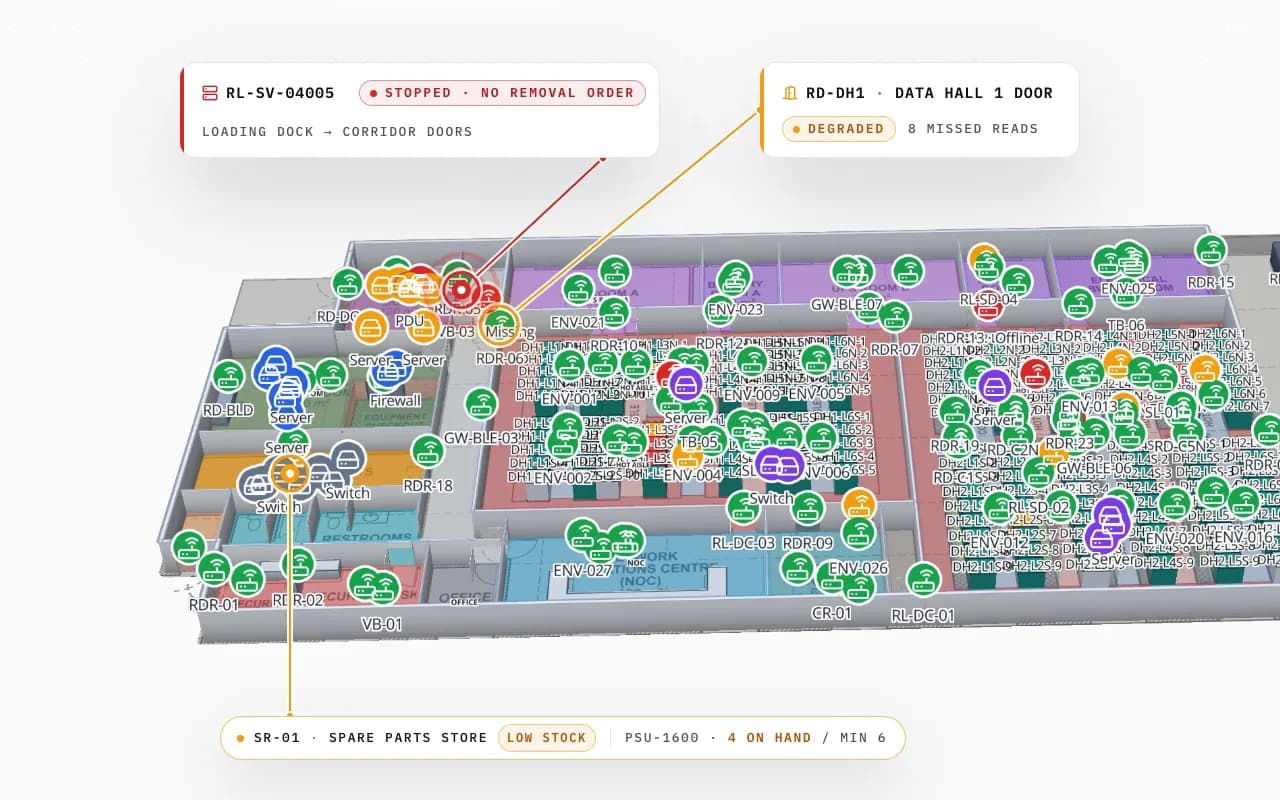
Tags and readers we work with are on RFID hardware — e.g. from Zebra, Chainway, SATO or Sanray (trademarks of their owners). Once the tags read reliably, the reads go on a live map: see RFID tool tracking, the RFID IT asset audit and RFID for retail stores.
Try the platform your data belongs on.
Spatial Map turns spreadsheets, sensor streams, and CAD drawings into one live 3D facility view — nothing to install, seven-day free trial.
Keep reading
- Deep-diveHow RFID stock counting works (and how accurate it really is)An RFID count reads hundreds of tags a second, but “accurate” hides two different numbers. How counts work, what accuracy to expect, and how to measure your own.
- Deep-diveWhat is indoor mapping? A practical guide (2026)Indoor mapping turns a building’s floor plans into a structured, multi-floor digital map. This guide explains how indoor maps are made, how they become digital twins, and how to choose software.
- Deep-diveIndoor wayfinding software: turn-by-turn directions on your floor planGPS stops at the front door. Here’s how Spatial Map builds walking routes from the floor plan you already maintain, gives visitors turn-by-turn directions in the viewer, and, honestly, where floors, lifts and accessibility fit in today.