
RFID handheld vs fixed reader vs gate: which do you need?
RFID handheld vs fixed reader vs gate: what each reader type answers, coverage, labour, the hard parts, and which to start with for counts, docks and exits.
Three ways to read a tag
Every UHF RFID project ends up choosing between three kinds of reader. A handheld goes to the tags. A fixed reader with antennas watches an area. A gate (or portal) watches a passage that everything must cross. They answer different questions, and most sites that run RFID well use more than one.
Side by side
| Handheld | Fixed reader + antennas | Gate / portal | |
|---|---|---|---|
| Answers | What is in this zone right now? Where is item X? | What is in this area, continuously? | What passed here, when, which way? |
| Data freshness | As often as someone counts | Seconds to minutes | At the moment of passing |
| Labour | A person per count | None after install | None after install |
| Infrastructure | None; a charger | Power/PoE, network, cabling, mounting | Same, plus a frame or pedestals |
| Typical range | Up to a few metres | Several metres per antenna | The width of the passage |
| Hard parts | Walk discipline, coverage | Dead spots, stray reads, cost of coverage | Read zone tuning, direction, neighbouring doors |
Handhelds: counts, audits, search
Handhelds are either integrated (a rugged Android device with a built-in UHF reader) or a sled that clips to a phone. They are how almost every retail RFID program counts stock, and how IT and fixed-asset teams audit rooms. Most also have a “Geiger counter” search mode that beeps faster as you approach a given tag — the quickest way to find one missing item.
The limit is people: data is only as fresh as the last count. See how RFID stock counting works for technique and accuracy.
Fixed readers: watching an area
A fixed reader drives one to eight (sometimes more) antennas mounted on walls, ceilings or shelves. Each antenna becomes a zone: a stockroom, a cage, a conveyor, a shelf. Overhead arrays that steer their beam can narrow a read to a smaller area, at a higher price. Antenna polarisation matters: circularly polarised antennas read tags in any orientation, at some cost in range; linear ones reach further when tag orientation is known.
Fixed coverage is where cost grows fastest — every zone needs antennas, cabling and tuning — so it is usually reserved for places where stock must be watched all the time: high-value stock, stockrooms, work-in-progress.
Gates and portals: choke points
A gate is a fixed reader framing a passage: a dock door (often two to four antennas), a store exit pedestal, a cage door, a corridor. Because everything must pass, one gate gives a lot of information for its cost. With two antenna zones, middleware infers direction from the order in which the zones see a tag.
- Stray reads — the next door’s pallet. Fix with antenna aiming, power, shielding and middleware filtering.
- Lingering items — a pallet parked in the doorway reads again and again. Filter by dwell, not just by read.
- Speed — fast forklifts and running people shorten the time in the field; test at real speeds.
Which do you need?
| If you need to… | Start with |
|---|---|
| Count a store or stockroom weekly | Handhelds |
| Audit IT assets or instruments | Handhelds, plus gates at the exits |
| Confirm receipts and loads | Dock-door portals |
| Stop items leaving unseen | Gates at exits and cage doors |
| Watch high-value stock all the time | Fixed readers in that area |
| Follow WIP through a plant | Fixed readers at stations, gates between areas |
Hardware we work with is listed on RFID hardware — e.g. handhelds, fixed readers and gates from Zebra, Chainway, SATO or Sanray (trademarks of their owners). Design help for portals and middleware is custom development.
All three on one map
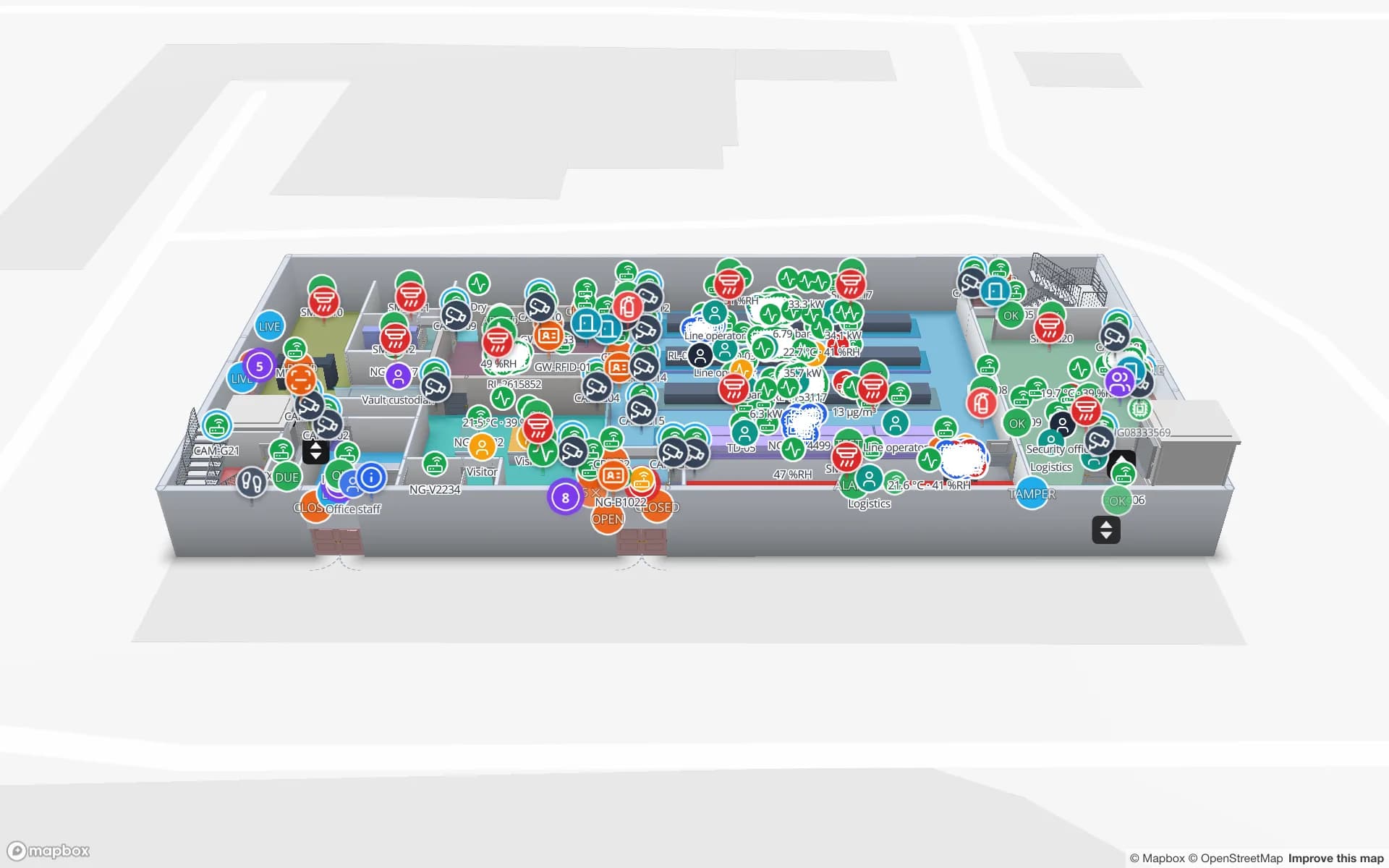
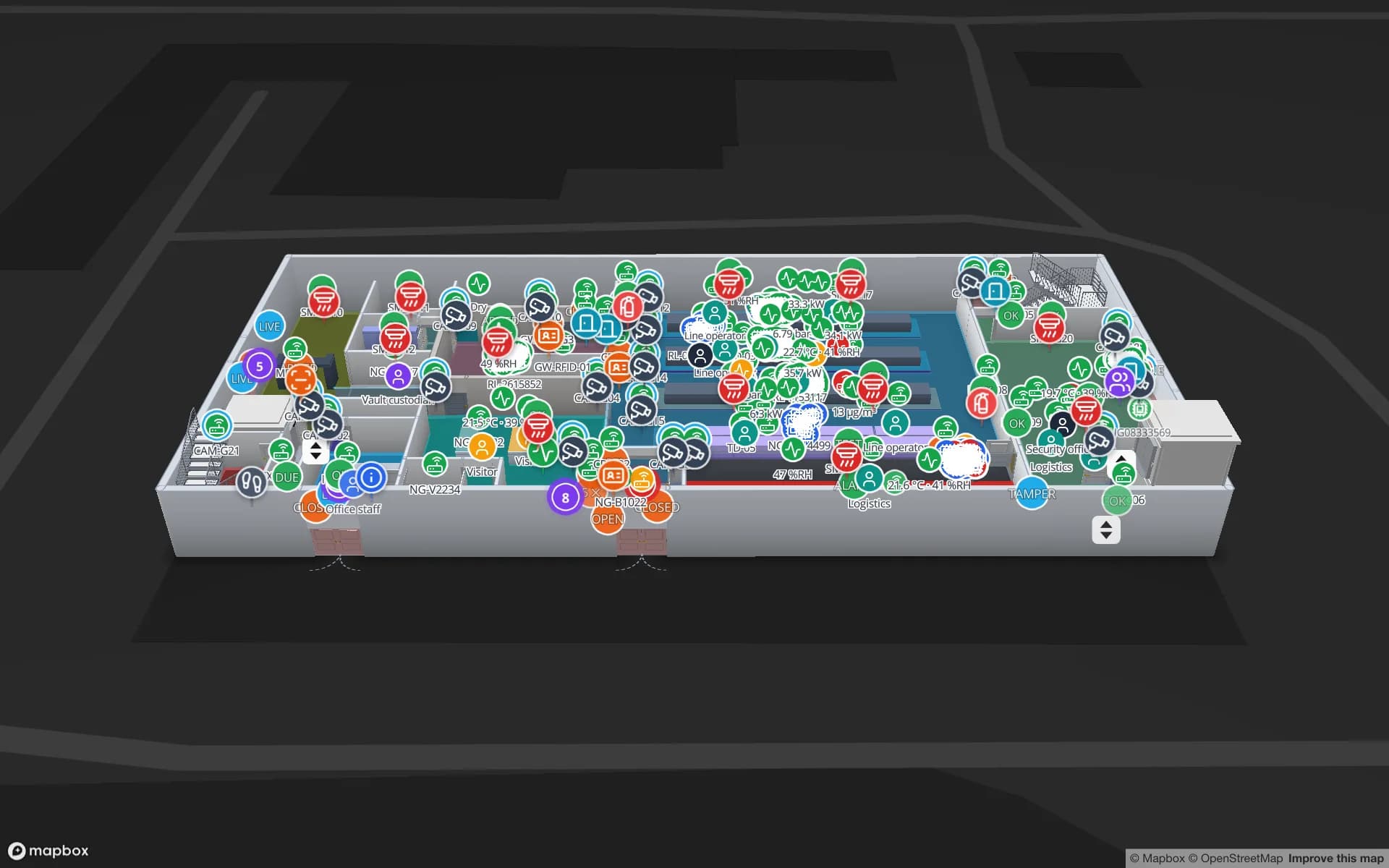
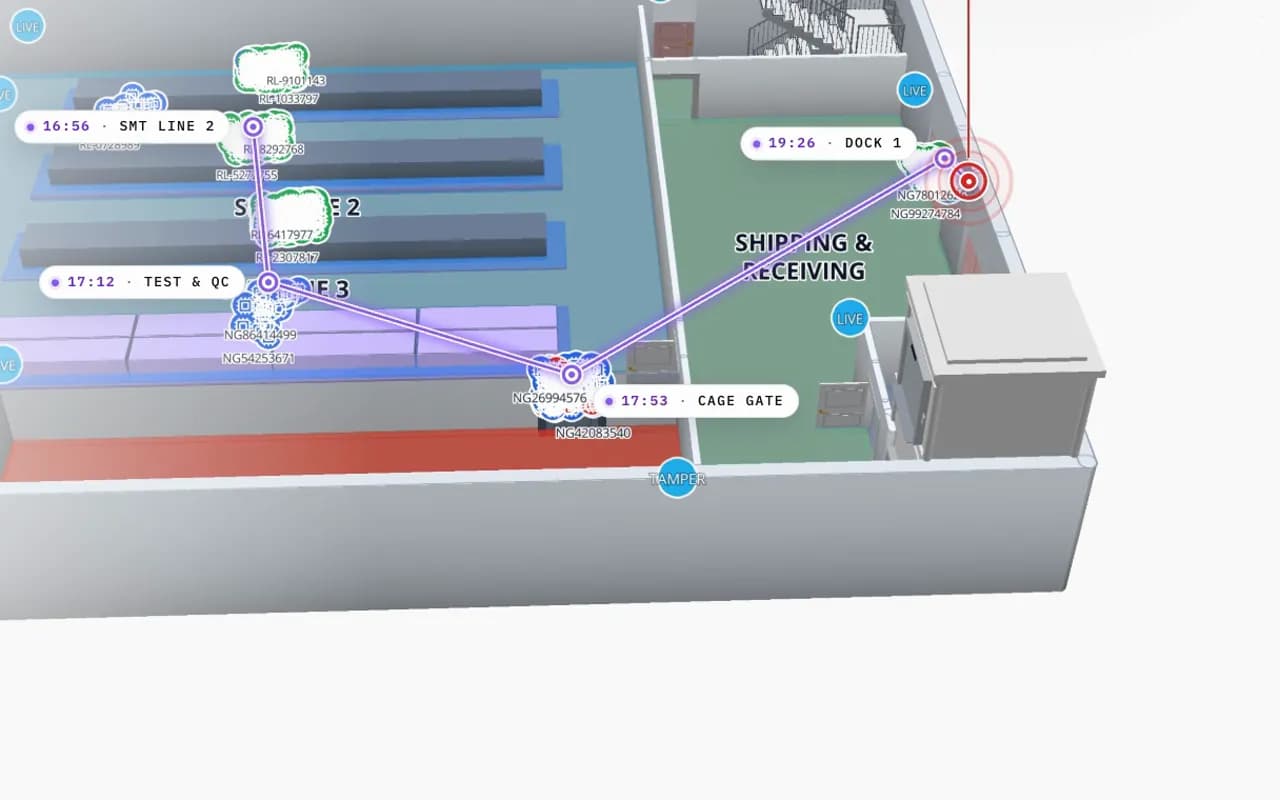
Handheld counts, fixed-reader zones and gate events are three feeds about the same building. In Spatial Map they become one picture: counted zones coloured by result, fixed-reader zones with what they currently see, gates with their last read and health, and the trail of reads from gate to gate. See the RFID gate system, RFID stock counting and RFID asset tracking software pages.
Try the platform your data belongs on.
Spatial Map turns spreadsheets, sensor streams, and CAD drawings into one live 3D facility view — nothing to install, seven-day free trial.
Keep reading
- ComparisonIndoor maps vs floor plans vs BIM: what’s the difference?Floor plans are pictures, BIM is a design model, an indoor map is just enough model for operations. How they differ, and which one fits which job.
- ComparisonUHF vs HF vs NFC RFID for inventory: which one to useUHF reads metres away and hundreds of tags at once; HF is short-range and copes with liquids; NFC is for phones. Which one fits your inventory, with a checklist.
- ComparisonHow to choose digital twin software: a 2026 buyer’s checklistEvery vendor demo looks good on its own sample data. This checklist covers the 15 questions that separate a live operational twin from a pretty floor plan, and how to prove the answers in a two-week pilot.