
RFID vs barcode for warehouse inventory: speed, cost and accuracy
RFID vs barcode for warehouse inventory: line of sight, count speed, cost, accuracy and durability compared, plus mixed approaches and five questions to decide.
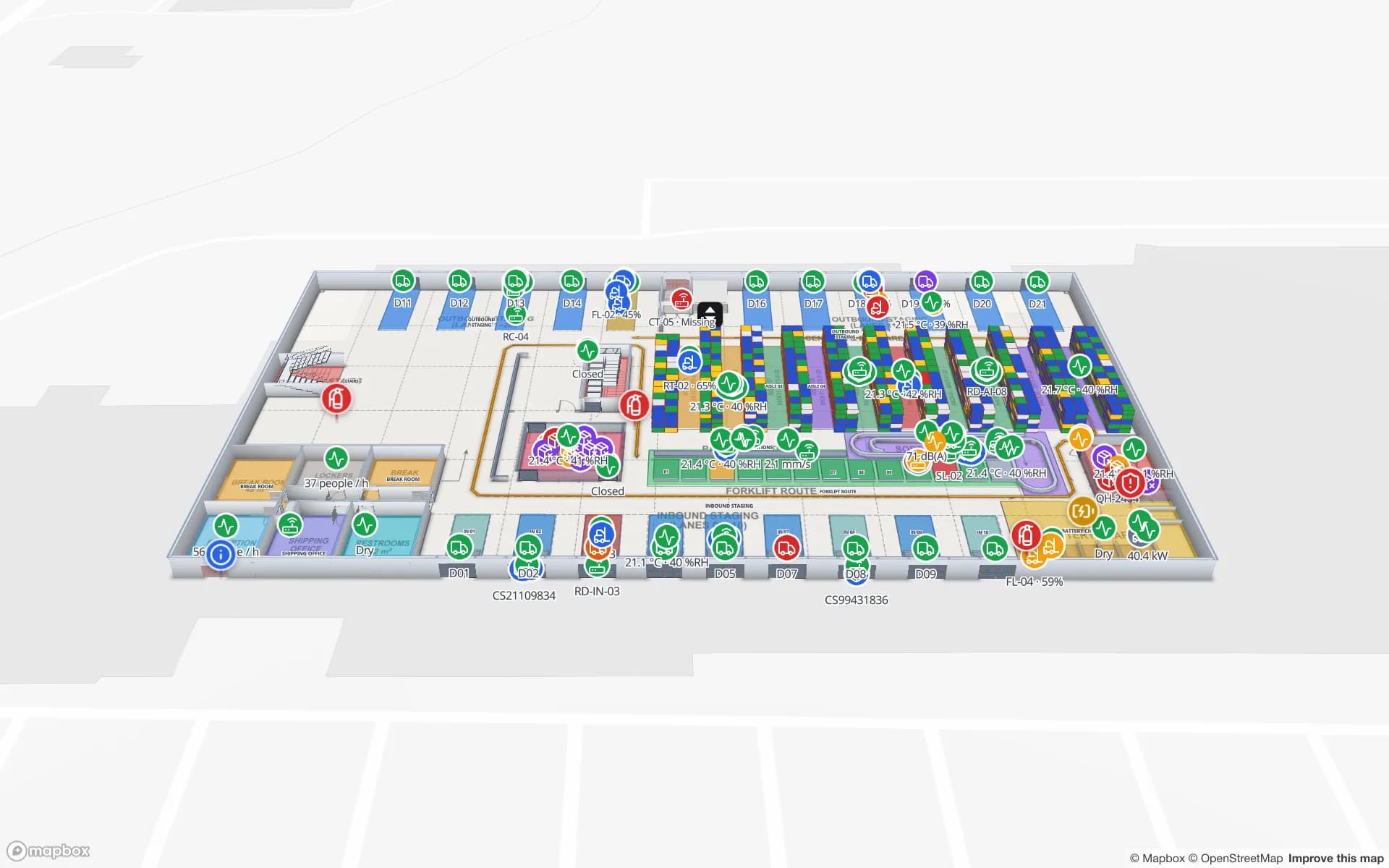
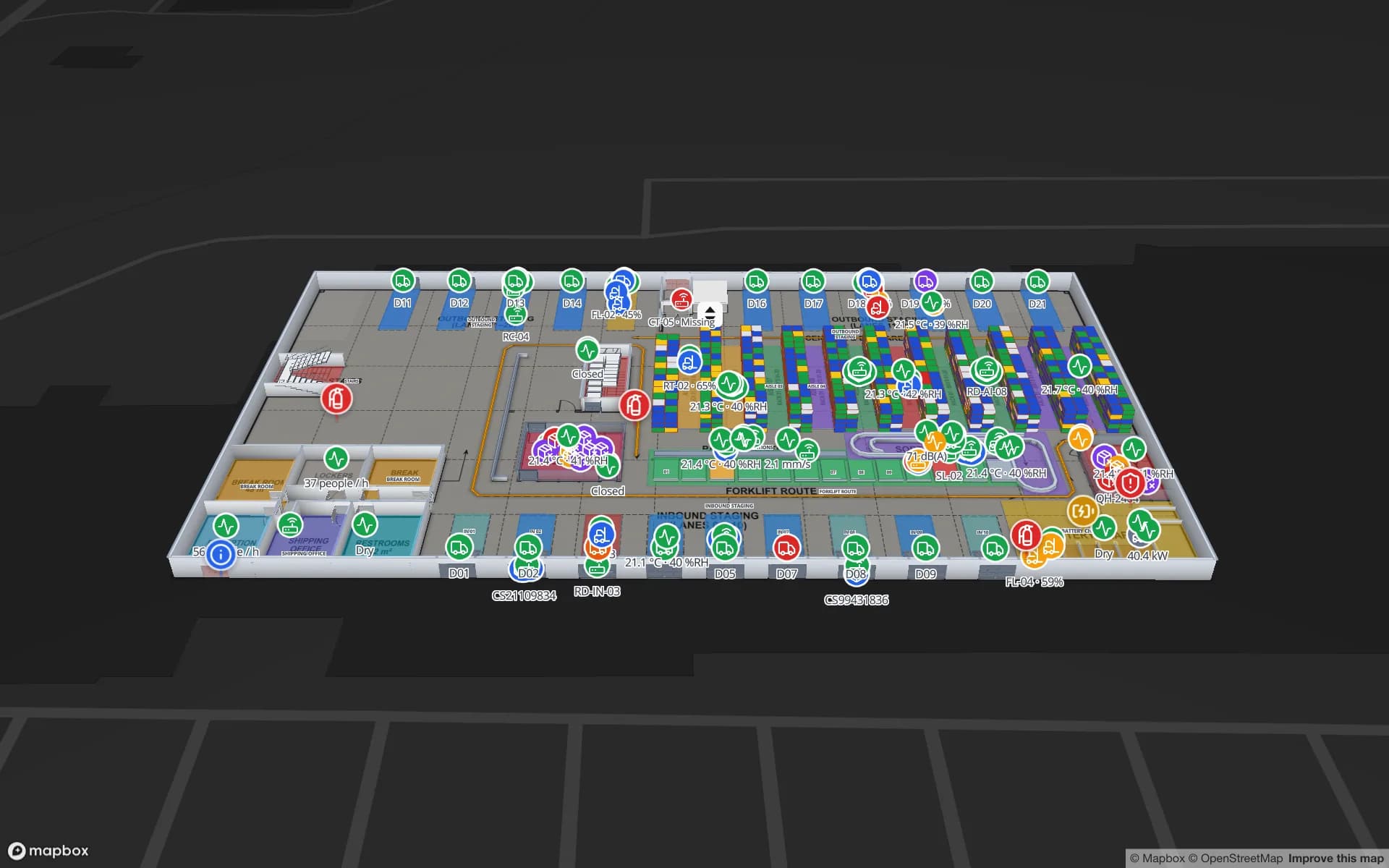
RFID vs barcode: the short answer
RFID vs barcode for warehouse inventory is a trade between cost per label and labour per scan. A barcode costs almost nothing to print but must be scanned one at a time, in line of sight. A passive RFID tag costs more but can be read without line of sight, from metres away, many at once. That makes RFID much faster for counts and for goods passing doors, and barcodes cheaper and simpler for everything else.
Most warehouses that adopt RFID keep barcodes too. The useful question is not which one wins, but where each one pays for itself.
RFID vs barcode at a glance
| Barcode (1D / 2D) | Passive UHF RFID | |
|---|---|---|
| Line of sight | Required | Not required |
| Items per scan | One | Many, often hundreds per second |
| Typical range | Centimetres to a few metres with long-range scanners | About 1 m to 10 m, depending on reader and tag |
| Label cost | Almost nothing if printed in-house | Higher; falls with volume |
| Reader cost | Low; phones can scan | Higher; needs RFID handhelds, sleds or fixed readers |
| Unique per item | Usually per product (SKU); 2D codes can be per item | Each tag has its own serial (EPC) |
| Durability | Can be torn, faded or dirty | Can be damaged; on-metal and rugged tags available |
| Automatic reads | Needs a person or camera tunnel | Gates, conveyors and overhead readers read without a person |
| Hard materials | Not affected by metal or liquids | Metal and liquids need special tags or placement |
Speed and accuracy
The biggest difference is count speed. With barcodes, someone must find each label, point at it and scan it. With RFID, a handheld reads a shelf or a full carton as the person walks past. Published pilots and vendor case studies often report counts that are many times faster, which is why sites that once counted twice a year can count weekly or daily.
Faster counts tend to mean better inventory accuracy, because errors are found sooner. Retail studies, widely quoted from university RFID research, have put typical store inventory accuracy at roughly two-thirds without item-level RFID and well above 90% with it. Treat those as directional; your own result depends on process, tag quality and how often you count.
RFID vs barcode across warehouse processes
The difference is not the same at every step. Here is how the two typically compare in the main warehouse processes:
| Process | With barcodes | With RFID |
|---|---|---|
| Receiving | Scan each carton or a pallet label; open cartons to check contents | A dock-door reader or handheld reads a whole pallet; tagged contents can be checked without opening |
| Putaway | Scan the item and the location label | Similar; RFID adds little unless shelves or forklifts carry readers |
| Picking | Scan each pick; fast and well understood | Often stays on barcodes; RFID helps where picks are verified in bulk |
| Cycle counts | Find and scan every label in a location | Walk the aisle with a handheld; whole shelves in one pass |
| Shipping | Scan cartons as they are loaded | A portal confirms what went through which door, without stopping |
| Returns | Scan and inspect each item | Read the returned batch at once, then inspect exceptions |
The pattern is clear: RFID gains most where many items are handled at once or pass a fixed point. Where a person handles one item at a time anyway, a barcode scan is already fast. The RFID warehouse management page covers dock-door portals and staging lanes.
Cost
Barcodes win on unit cost. A printed label is close to free and almost any phone can scan it. RFID adds the tag, the readers and usually software and integration. Whether RFID pays back depends on how much labour it saves, how much stock error costs you and how many items move through each location.
- RFID tends to pay back where you count often, hold many units per location, ship and receive in volume, or lose money to stock errors and shrink.
- Barcodes tend to stay for bulky single items, slow-moving stock and anywhere one scan per item is already quick.
- Tagging at source helps: if suppliers tag goods, your cost per item falls.
For a full breakdown of what an RFID project costs, read RFID system cost.
Mixed approaches that work
- 1Dual labels
Print a barcode and human-readable text on every RFID label. If a tag fails, staff can still scan the code.
- 2RFID on cartons and pallets, barcodes on units
Tag the handling unit so dock doors read whole loads, and keep unit barcodes for picking.
- 3RFID for high-value or high-shrink lines
Start with the products where errors cost most, and leave the rest on barcodes.
- 4RFID for counts, barcodes for transactions
Use handheld RFID for fast cycle counts while receiving and picking stay on existing barcode workflows.
Whichever mix you choose, keep one item master so a barcode scan and an RFID read of the same product land on the same record.
Five questions to decide
- How often do you count? Rarely, and barcodes may be fine. Weekly or more, and RFID saves real time.
- How many units per location? A bin with 200 units is where RFID bulk reads shine.
- Do goods pass choke points? Dock doors and conveyors suit fixed RFID readers.
- What are the items made of? Metal and liquids need tag testing before you commit.
- Can your systems use the data? RFID creates more events; your WMS or another system must accept them.
Seeing the result on a map
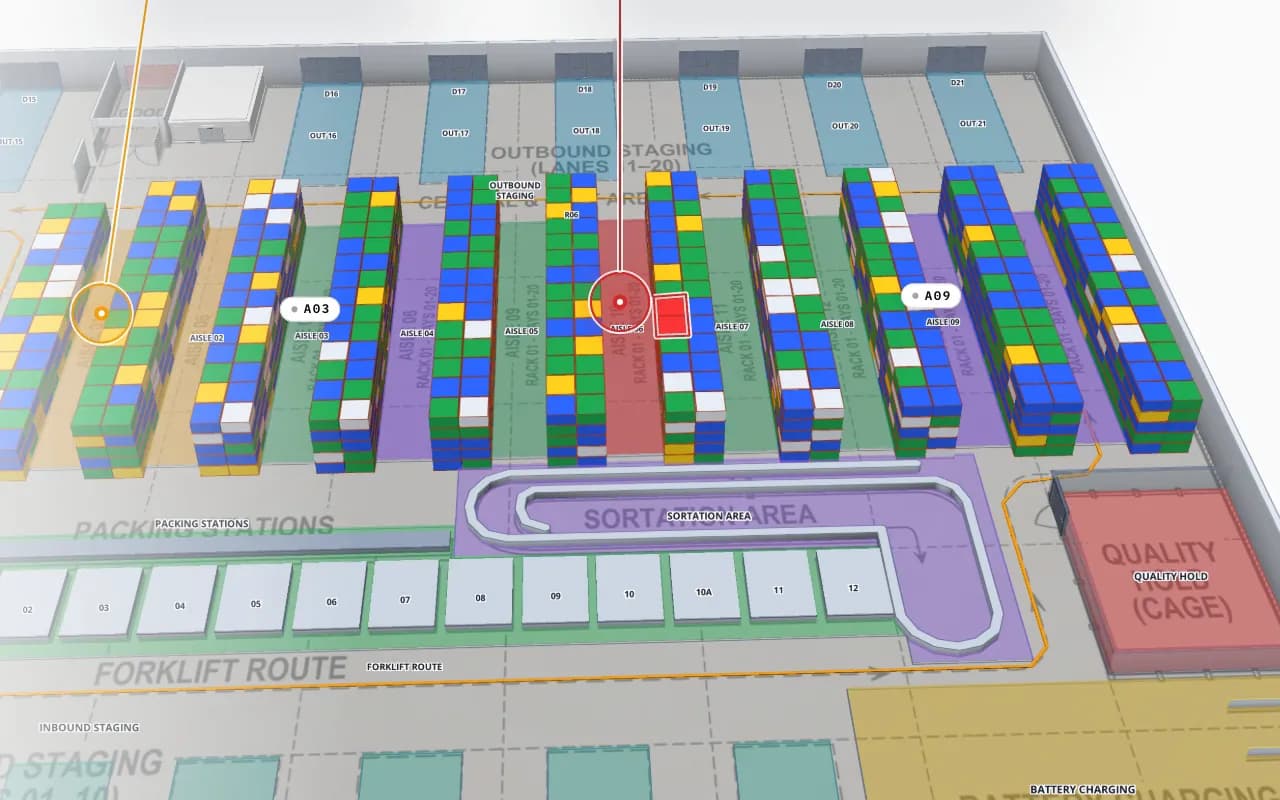
Spatial Map shows stock and reads on a live 3D map of the warehouse, whether the data came from barcode scans or RFID reads. Rack locations can be coloured by status (full, low, empty, blocked), and count results can be compared by zone, from tables your WMS, middleware or scripts write to. See the RFID inventory management system and RFID stock counting pages for how that looks with demo data.
Quick answers
Will RFID replace barcodes in warehouses? Not completely. Barcodes stay cheap and universal, so most warehouses use RFID where it saves labour and keep barcodes elsewhere.
Can a barcode scanner read RFID? No. Barcode scanners read printed codes optically. RFID needs a radio reader, though some handhelds combine both.
Is RFID more accurate than barcodes? RFID makes frequent counts practical, which usually improves inventory accuracy. A single barcode scan is very reliable; the difference comes from how often and how completely you can count.
Try the platform your data belongs on.
Spatial Map turns spreadsheets, sensor streams, and CAD drawings into one live 3D facility view — nothing to install, seven-day free trial.
Keep reading
- ComparisonBLE vs UWB vs Wi-Fi for RTLS: accuracy, cost and infrastructureBLE is cheap and room-level, UWB is precise and costly, Wi-Fi reuses what you have. A vendor-neutral comparison for RTLS, with a five-step way to choose.
- ComparisonEAS vs RFID anti-theft gates: what each one tells youAn EAS gate knows something left; an RFID gate knows what left. How AM, RF and RFID gates compare, the trade-offs, and a step-by-step path from EAS to RFID.
- ComparisonIndoor maps vs floor plans vs BIM: what’s the difference?Floor plans are pictures, BIM is a design model, an indoor map is just enough model for operations. How they differ, and which one fits which job.