
RFID vs BLE for asset tracking: how they differ and when to use both
RFID vs BLE for asset tracking: power, tag cost, range, location detail and infrastructure compared, when each fits best, and how to combine both on one map.
RFID vs BLE: the short answer
RFID vs BLE for asset tracking comes down to one question: do you need to know where something is all the time, or only when it passes a reader? Passive RFID tags have no battery, cost little and are read when a reader is close by, so they suit large numbers of items checked at doors, shelves and counts. BLE tags carry a battery and broadcast continuously, so they suit fewer, valuable, moving assets that you want to find at any moment.
Many sites end up using both. This guide compares the two, shows where each one fits and explains how they work together on one map.
How each one works
Passive RFID (usually UHF, also called RAIN RFID) uses a reader that sends out a radio wave. A tag in range takes its energy from that wave and replies with its ID. Nothing happens until a reader is near, so a read is an event at a known place: a handheld in aisle 4, a portal at dock door 3, an antenna in a shelf.
BLE (Bluetooth Low Energy) tags contain a small battery and broadcast a short message several times a second or every few seconds. Fixed gateways hear them and forward what they hear to a server. Software then decides where each tag is: the room of the gateway that hears it best, or an x/y position worked out from several gateways. The Bluetooth beacon tracking page explains tags, beacons and gateways in more detail.
RFID vs BLE at a glance
| Passive RFID (UHF) | BLE | |
|---|---|---|
| Power in the tag | None | Battery, typically a coin cell or larger |
| Tag life | Indefinite while the tag is undamaged | Months to several years, depending on how often it broadcasts |
| Tag cost | Low, especially paper inlays at volume | Many times higher than a passive label |
| Tag size | Thin labels to rugged hard tags | Usually a small plastic device or card |
| Typical range | About 1 m to 10 m, depending on reader and tag | Tens of metres in open space, less through walls |
| When you know location | When a reader sees the tag | Continuously, while gateways hear it |
| Location detail | Which read point saw it last | Room or zone; metre-level coordinates with dense gateways and an RTLS engine |
| Infrastructure | Readers at doors, shelves, conveyors; handhelds for counts | Gateways spread across the area, with power and network |
| Reads many tags at once | Yes, hundreds per second | Yes, but each tag broadcasts on its own schedule |
| Read by phones | Not without a reader sled | Yes, phones can hear BLE |
When passive RFID is the better choice
- You have many items. Thousands of garments, cartons, files or tools. A battery in each would cost too much.
- You count rather than follow. Handheld cycle counts and shelf audits tell you what is where, at the time of the count.
- Movement goes through choke points. Dock doors, shop exits and room doors are natural read points for gates.
- Items are small or flat. A label fits where a BLE tag would not.
- You cannot change batteries. Nothing to replace, ever.
The limit is the blind spot between reads. If a pallet is put down in the wrong aisle and no reader passes it, RFID does not know until the next count. See RFID asset tracking software for how reads become positions on a floor plan.
When BLE is the better choice
- Assets move often and need finding quickly. Carts, wheelchairs, forklifts, test equipment, loan devices.
- You need presence, not just passage. "Which room is it in now" rather than "when did it last go through a door".
- There are no natural choke points. Open floors, labs and halls where gates would not work.
- People are tracked with consent. Staff badges for safety or workflow, where that is lawful and agreed.
- The asset is worth the tag. A BLE tag on an expensive instrument pays for itself the first time it saves a search.
The limits are battery management and infrastructure. Every tag needs a battery check, and gateways need power, network and a sensible layout. The BLE asset tracking page covers zone-level versus coordinate setups.
What each one takes to run
The purchase price is only the start. The work of keeping each system accurate looks quite different:
- RFID upkeep is about read points and tags. Gates drift out of tune when displays move or doors are refitted, tags get damaged or removed, and new stock needs tagging as it arrives. Counts only happen when someone walks with a handheld.
- BLE upkeep is about batteries and gateways. Every tag reports its battery level, so plan who replaces or recharges them and how often. Gateways need power and network, and a gateway that goes offline creates a silent hole in coverage.
- Both need clean names. A reader, gateway or zone called "GW-17" in the data must match a door or room on your map, or nobody can act on it.
A useful rule of thumb: RFID cost grows with the number of items and read points, BLE cost grows with the number of tags and the area you need to cover.
Using RFID and BLE together
The two technologies answer different questions, so combining them is often the cheapest way to cover a building.
- 1Tag items with RFID
Stock, cartons and low-value items get passive tags. Gates and handheld counts track them.
- 2Tag mobile equipment with BLE
Forklifts, carts and valuable instruments get BLE tags so you can find them between counts.
- 3Share the infrastructure plan
Put RFID readers where things pass and BLE gateways where things stay. Both need power and network, so plan them in one survey.
- 4Put both on one map
Show RFID read events and BLE presence on the same floor plan, so staff look in one place.
Some vendors sell hybrid tags with both an RFID chip and a BLE radio. They can make sense for returnable assets that pass gates and also need finding on the floor, at the cost of a battery.
If you are also weighing UWB or Wi-Fi positioning, the RTLS software page describes how the main real-time location technologies differ.
One map for both
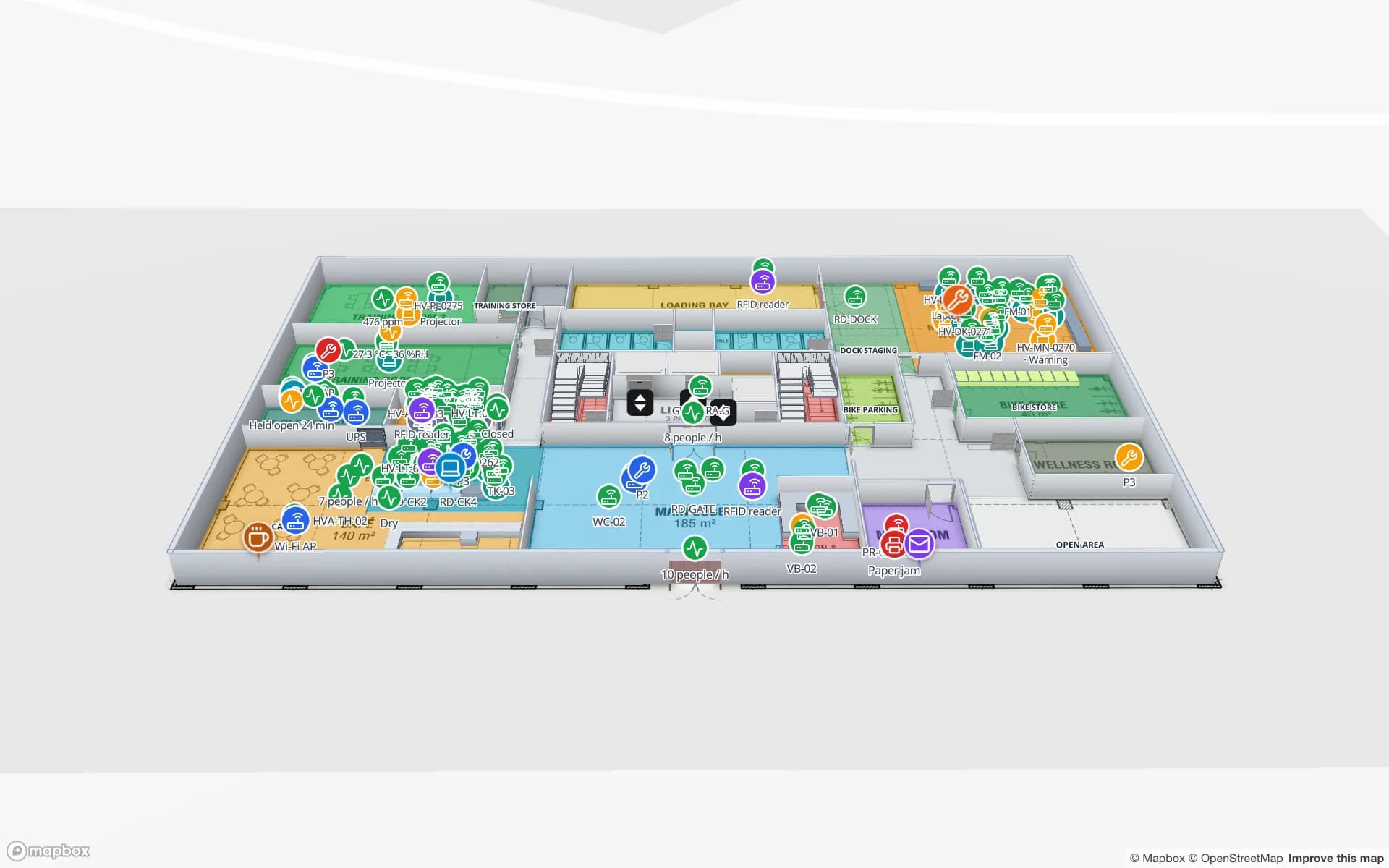
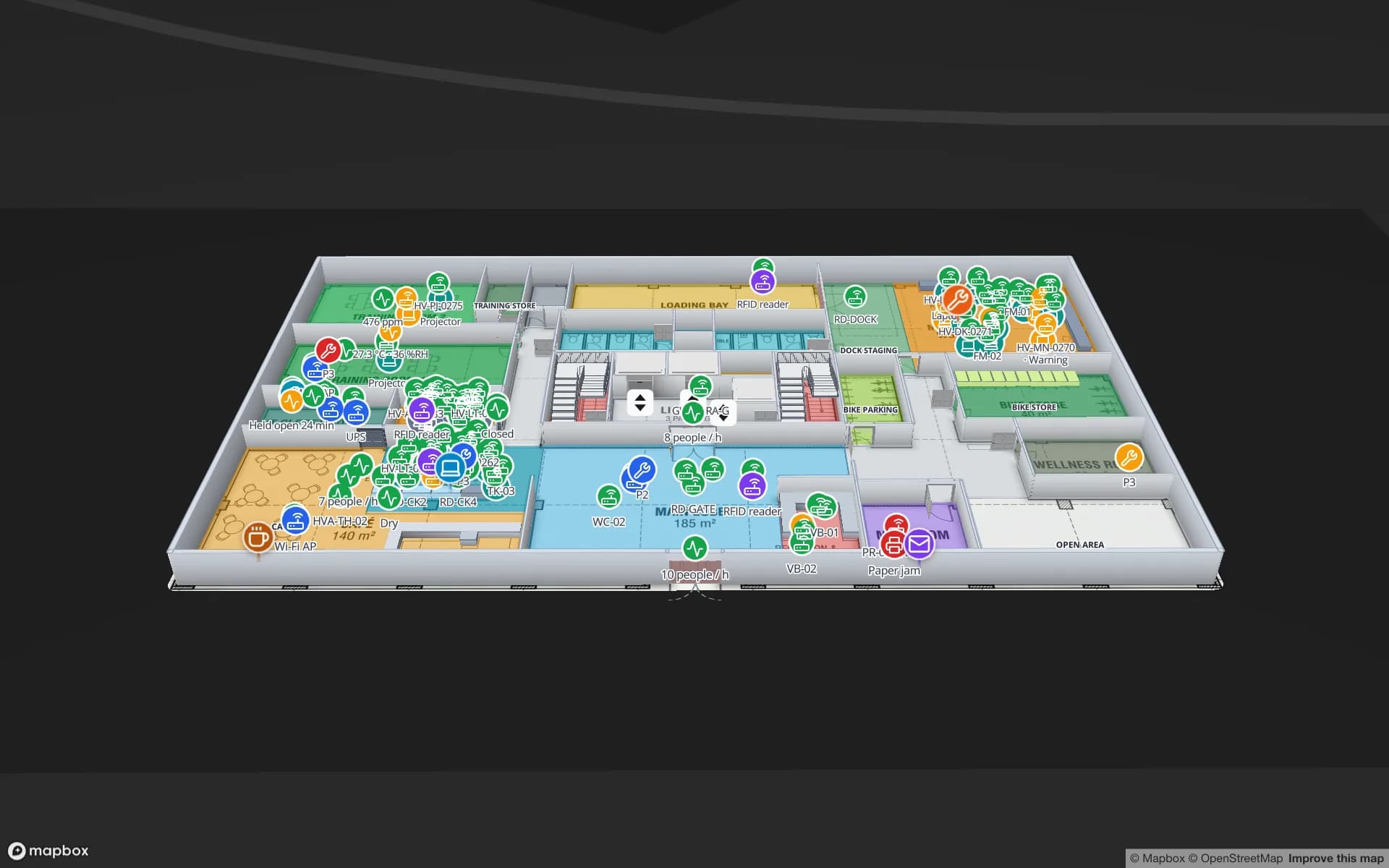
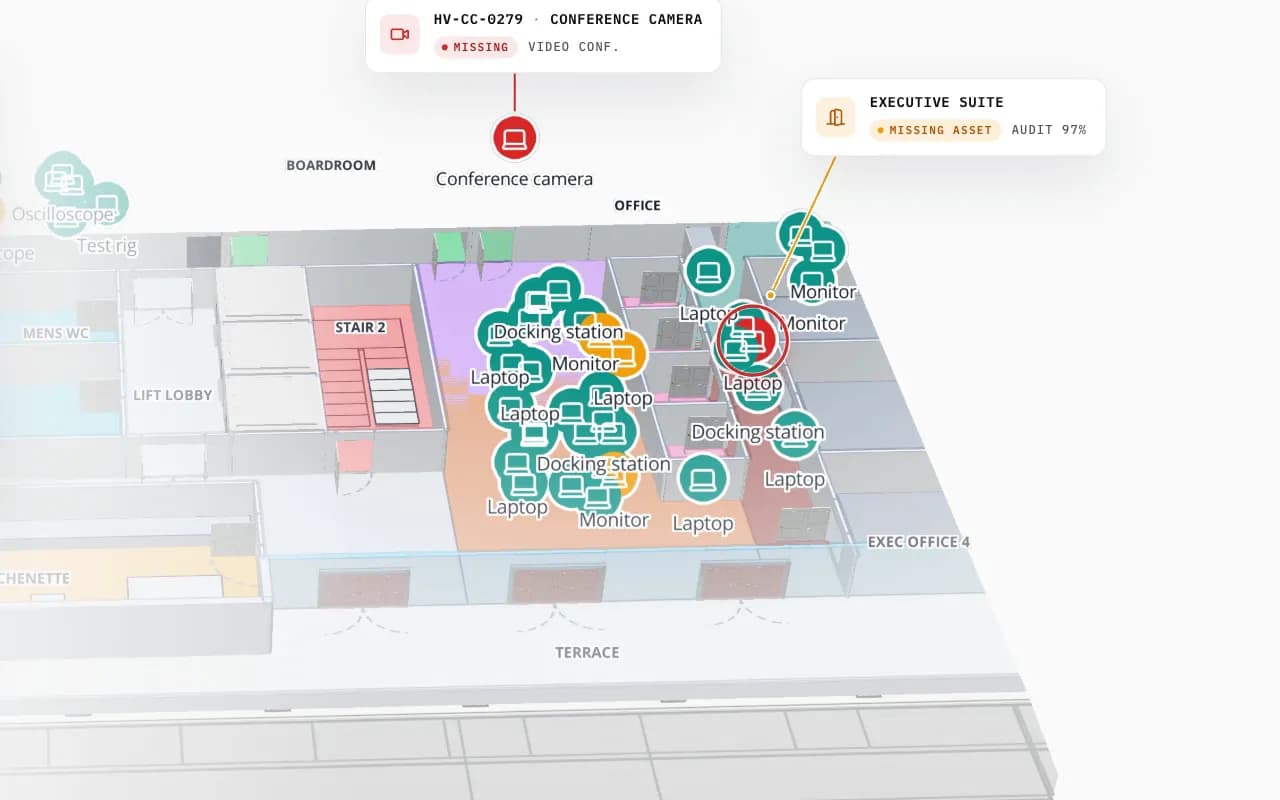
Spatial Map shows RFID reads and BLE positions side by side on a live 3D floor plan. It does not compute positions itself: your RFID middleware and your BLE gateway software or RTLS engine send rows to Spatial Map tables, and data links place them on the map as markers or room presence. In the Retail Mart demo, RFID readers sit at the exits while BLE trolleys and staff move across three floors.
Quick answers
Is BLE more accurate than RFID? They measure different things. RFID tells you exactly which reader saw a tag and when. BLE tells you roughly where a tag is all the time; with enough gateways and an RTLS engine that can reach metre level.
Is RFID cheaper than BLE? Per tag, passive RFID is far cheaper. The total depends on infrastructure: many gates can cost more than a sparse set of BLE gateways, and the reverse is also true.
Can a smartphone replace BLE gateways? Phones can hear BLE tags, which suits occasional searches. Continuous tracking still needs fixed gateways.
Try the platform your data belongs on.
Spatial Map turns spreadsheets, sensor streams, and CAD drawings into one live 3D facility view — nothing to install, seven-day free trial.
Keep reading
- ComparisonBLE vs UWB vs Wi-Fi for RTLS: accuracy, cost and infrastructureBLE is cheap and room-level, UWB is precise and costly, Wi-Fi reuses what you have. A vendor-neutral comparison for RTLS, with a five-step way to choose.
- ComparisonEAS vs RFID anti-theft gates: what each one tells youAn EAS gate knows something left; an RFID gate knows what left. How AM, RF and RFID gates compare, the trade-offs, and a step-by-step path from EAS to RFID.
- ComparisonIndoor maps vs floor plans vs BIM: what’s the difference?Floor plans are pictures, BIM is a design model, an indoor map is just enough model for operations. How they differ, and which one fits which job.