
RFID system cost: every component, and what drives each one
RFID system cost, broken down: tags, readers, handhelds, gates, printers, middleware, software, integration and labour, what drives each and which costs recur.
What makes up RFID system cost
RFID system cost is the sum of nine things: tags, readers, handhelds, gates or portals, printers and encoding, middleware, software, integration and labour. Hardware is the part people price first, but it is rarely the whole bill. On many projects, tagging existing stock, installation and connecting RFID to the systems you already run cost as much as the devices, or more.
This guide does not quote market prices. They change quickly, vary by region and volume, and any single figure would mislead. Instead, it lists each cost component, what drives it up or down, and which costs recur. With that list you can ask suppliers for comparable quotes and spot what a quote leaves out.
The nine cost components
| Component | One-off or recurring | What drives the cost |
|---|---|---|
| Tags | Recurring for consumables; one-off for re-usable tags | Volume, form factor (paper inlay, hard tag, on-metal, laundry, high-temperature), chip, custom printing |
| Fixed readers and antennas | One-off, plus maintenance | Number of read points, antenna count per reader, mounts, cabling, power over Ethernet |
| Handheld readers | One-off, with battery and repair costs | Built-in reader vs a sled on a phone, ruggedness, number of staff counting at the same time |
| Gates and portals | One-off, plus tuning | Number of doors, enclosures, shielding, installation work, visual or audible signals |
| Printers and encoding | One-off printers; recurring labels and ribbons | Print volume, label size, whether a supplier pre-encodes tags for you |
| Middleware | Licence or subscription, or a build | Reader count, filtering and smoothing rules, edge devices, monitoring |
| Software | Usually a subscription | Number of sites and users, modules (counts, gates, maps, reports) |
| Integration | Project cost, then upkeep | Which WMS, ERP or POS, how clean the item master is, how many systems need the data |
| Labour | Project cost, then some ongoing | Site survey, installation, tagging existing stock, training, process changes, support |
Readers, handhelds and gates
- Fixed readers sit at one place and need antennas, mounts, network and power. A four-antenna reader at a dock door is a different cost from a single-antenna reader on a shelf.
- Handhelds are either all-in-one rugged devices or reader sleds that pair with a phone. The count is usually set by how many people count at once, plus spares.
- Gates and portals add enclosures, shielding and tuning time. A gate that reads tags from the shelf next to it is worse than no gate, so the installation effort is real.
- Printers matter if you tag items yourself. A supplier can also deliver pre-encoded labels, which moves the cost into the tag price.
If you already own readers, you may not need to buy more. Our team integrates hardware clients already have with the vendors’ own SDKs and APIs; the RFID hardware integration page lists the device types we work with.
Middleware, software and integration
Raw RFID reads are noisy. The same tag can be read hundreds of times a minute by several readers. Middleware turns that stream into events people can use, such as "carton 1042 passed dock door 3 at 10:14". It may run on an edge device, on a server or inside the reader vendor’s software.
Software then shows and stores those events: counts, gate trails, exceptions and reports. Integration connects all of it to your item master and your WMS, ERP or POS, so a tag number means a product and a read means a stock movement. Integration cost depends heavily on the state of your existing data. Clean product records and stable identifiers make it far cheaper.
Where off-the-shelf software does not fit, this is the part that gets built: handheld apps, edge services and back-office screens. See custom RFID software development for how that work is scoped.
Labour: the line most budgets miss
- 1Site survey
Walk the building with real tags and a reader, and test each planned read point before buying hardware in volume.
- 2Installation
Cable runs, mounts, power, network ports and gate tuning, often outside opening hours.
- 3Tagging existing stock
Every item already on the shelves needs a tag before the first full count means anything. This is often the single biggest labour cost.
- 4Training and process change
Staff need to know when to scan, what an exception means and who fixes it.
- 5Ongoing support
Readers get moved, cables get cut, handhelds get dropped. Someone has to notice and fix it.
Ways to keep RFID system cost down
- Start with one use case. Counting one zone or one dock door gives you real numbers faster than a full design.
- Tag at source where suppliers can apply tags before goods arrive.
- Use handhelds before gates. Periodic handheld counts often deliver much of the value without the installation cost of fixed infrastructure.
- Re-use what you own. Existing readers, networks and phones can often be integrated rather than replaced.
- Keep a pilot honest. Measure read rates, count time and exceptions, and decide on the rollout from those results.
The RFID warehouse rollout plan sets out how to stage a pilot and scale it.
Where Spatial Map fits in the budget
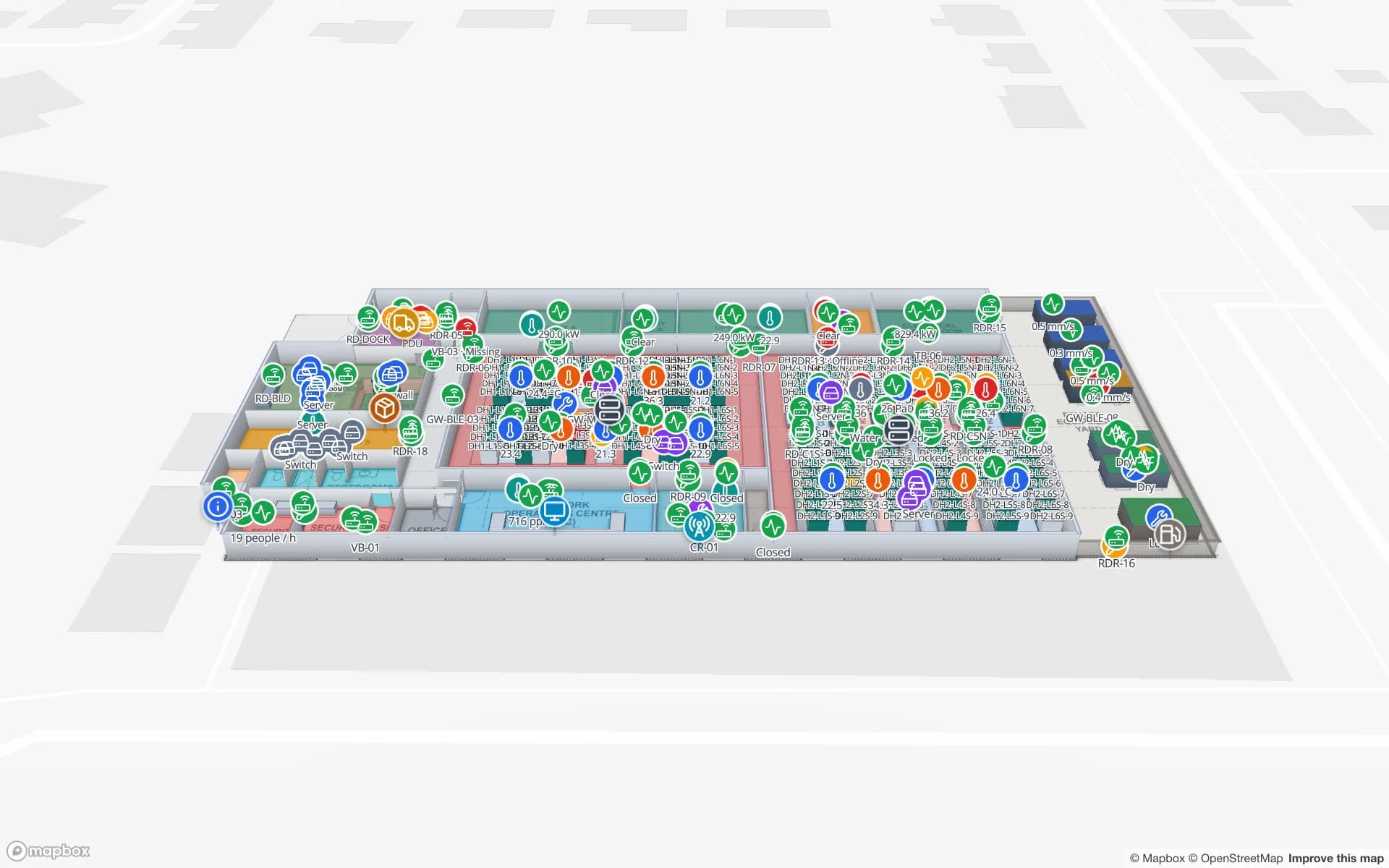
Spatial Map is the map and reporting layer, not the hardware. It shows RFID reads, stock and gate events on a live 3D floor plan of your building, from a table your middleware writes to or an endpoint it already exposes. Pro costs $60 a month or $600 a year for up to 4 facilities, with a 7-day free trial for 5 facilities and no card. A self-hosted open-source edition is available under the MIT licence, run with Docker. Tags, readers, installation and integration are separate costs, and they will usually be the larger part of the project.
To see what the software side looks like with demo data, open the RFID asset tracking software page.
Quick answers
Why do RFID quotes vary so much? Because they cover different scopes. One quote may include installation, tagging and integration; another may list only devices. Compare quotes line by line against the nine components above.
Is RFID cheaper than barcodes? Per label, no: a printed barcode costs almost nothing. RFID pays back through faster counts, fewer errors and data that barcodes cannot capture without a scan.
What is the biggest hidden cost of RFID? Usually labour: tagging existing stock, tuning read points and changing how people work. Integration with existing systems comes a close second.
Try the platform your data belongs on.
Spatial Map turns spreadsheets, sensor streams, and CAD drawings into one live 3D facility view — nothing to install, seven-day free trial.
Keep reading
- Deep-diveAzure Maps Creator is retired: what it means and your optionsMicrosoft retired Azure Maps Creator on 30 September 2025 and deleted its indoor data. What Creator did, what you can still rebuild from, and how to choose where to move.
- Deep-diveHow accurate are BLE beacons? Four methods, and why results varyFrom room-level to sub-metre: BLE accuracy depends on the method, the building and the update rate. The four methods, what affects them and seven questions for vendors.
- Deep-diveDoes GPS work indoors? Why it fails and what works insteadGPS barely works inside buildings: the signals are too weak and bounce off everything. Here is why, how indoor positioning options compare, and why each one still needs an indoor map.